Supporting and navigating your child’s journey with learning difficulties can be an intimidating process, especially in the early stages of investigating the situation.
Queensland schools support students with learning disorders by providing access to a range of supports tailored to meet individual needs.
Seeking the support of your child’s school teachers is an important step to understanding how they are progressing, what support they are receiving and working together towards a plan for your child’s development.
Once you arrange a parent-teacher interview, it is important to be prepared and know how to approach the conversations to ensure you get the most out of your meeting.
Code Read Dyslexia Network shared “7 Tips for meeting with your child’s school” written by Sarah Mitchell, Dyslexia and Literacy Consultant, that can help you enter the parent-teacher meeting confidently, with topics including:
Prepare
Keep all reports, emails, and notes in one folder for easy reference. Research effective teaching strategies and prepare key questions. Focus on solutions, practice responses, and stay constructive to ensure the best support for your child.
What to Ask?
Ask if your child has an Individual Education Plan (IEP) and request assessment reports. Inquire about interventions, their effectiveness, and whether they are evidence-based. Clarify what accommodations are provided and ensure the IEP includes targeted support, not just adjustments.
Put everything in writing
Take notes during the meeting and email them to attendees for confirmation. Record key points, action items, and deadlines. Request a follow-up review date and details on how progress will be measured.
Use time wisely
Prioritise key concerns, focus on solutions, and ask necessary questions. Stay future-focused and arrange follow-ups if needed.
Follow up
Check in after two weeks and maintain monthly communication. Collaborate with teachers rather than relying on your child for updates.
Leave silent space
Ask direct questions and allow time for responses. Silence can encourage deeper discussion and problem-solving.
Educate respectfully
Share concise resources with teachers and inquire about learning difficulty training. Support their knowledge without being confrontational.
For more information and resources contact our team or check out our library. Take the first steps towards your child’s future!
Click Here to Download the Guide

The Speld Qld Team of Education Advisors receive hundreds of calls each year where parents, carers and guardians report that their child is being supported well in their school setting. The classroom teachers are aware of the young person’s additional needs and are making suitable adjustments to ensure their access to the curriculum is on an equitable basis.
Unfortunately, we also speak to quite a number of frustrated parents who report little awareness of, or support for children with either a diagnosed, or yet to be diagnosed learning need, or a learning difference that impacts their progress. In this, and all cases to be honest, we recommend parents advocate for their children’s needs.
For parents in this context, advocacy means getting support from another person to help you express your views and wishes, and help you stand up for your child’s rights. What that means in the real world is that you might need to become a persistent, possibly slightly annoying parent which the school knows will follow up how and when adjustments are being accessed and will chase them up if they are not made available.
The reason to advocate for your child’s needs, apart from ensuring your child has equitable access to the curriculum, is that the school has an obligation to make relevant adjustments to support individuals. These are legislated in the Disability Standards for Education (2005) and the Disability Discrimination Act (1992). The Queensland Curriculum and Assessment Authority (QCAA) outlines their principles of Equity in education on their website.
The QCAA is committed to Queensland students accessing a fair and just, inclusive education which provides:
As our team often say to parents, a lot of the value in the psychoeducational assessments carried out by our psychologists is that the assessment reports have recommendations and strategies that schools should be able to take and implement in a straightforward manner. The assessment reports are valuable as the strategies line up with those reasonable adjustments in bold above, that can help pupils access their education on the same basis as their peers.
Improving your understanding of your child’s additional need and the ways a school can support them is always going to help. Please remember that understanding the causes and effects of, for example, dyslexia is very useful. However, there is no generic dyslexic pupil, so the support that is needed is going to be very individual to each individual.
The assessment report will provide a list of recommended and individualised supports which are based around the person’s individual profile. These supports are recommended to support the individual who was assessed. For example, having a reader and a scribe available may be useful for some, their use may not be appropriate for all.
Check the recommendations and strategies, ask the person being supported what works for them, then approach the school with a list of effective supports that can work for your child.
Schools have staff who may change roles, or are replaced. Pupils progress through each academic year and build relationships with a new team of teachers as they go. New faces mean that your child’s needs will need to be passed on to whoever is currently best placed to support them. Hopefully, your school’s learning support team will make new staff aware of any additional support needed, possibly through the use of a learner profile (the name of which will vary between school settings).
In case your child’s needs are not distributed, email staff at the beginning of each year, semester, or term, or in the run up to an exam block. Outline the supports that are currently working for your child, or update staff on how those needs have changed. As pupils develop, their support needs can change so please check in with your child to ensure the supports you are advocating for are still useful, and listed in the most current assessment report.
If you are heading into a meeting with your school, prepare a list of questions or points for discussion. Before you leave the meeting check that any items that need to be actioned have a follow up date, hopefully with a suitable person to provide feedback. Remember, you are part of a team working toward improving the adjustments provided to your child, but also the other pupils in their class who may also need support.
Self advocacy by pupils is a great thing to work toward. If your child is happy to let staff know the adjustments they need, it can build ownership, independence and confidence. However, classrooms are busy places, staff can be seen as scary and unapproachable and the desire to not stand out may be overwhelming. Encourage self-advocacy, but it may arrive in very small steps.
It is likely to be a long and stressful journey but any advocacy by you that can ensure relevant adjustments are consistently in place will take a big cognitive load off your child. Knowing they can go through their school day using strategies to reduce or work around their additional need removes a big stressor from pupils that may already be struggling to keep up.
Be that slightly annoying parent who will pop up in a teacher’s inbox, or in person to remind them that some of their pupil needs a bit more support. When they understand that the easiest way to not have to deal with you is to support the pupils in their class, hopefully adjustments will be consistently in place.

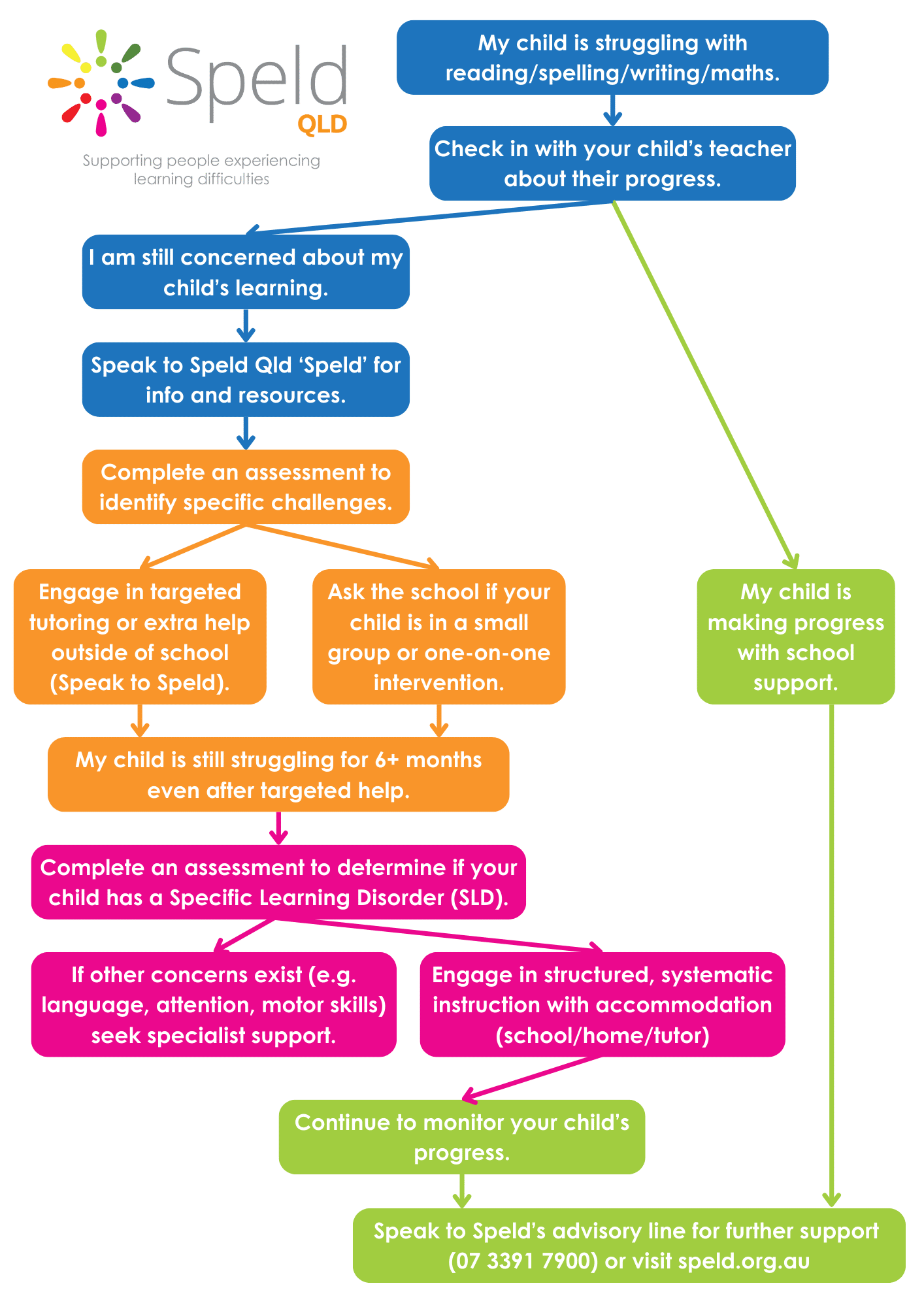
Consider a learning assessment to identify specific areas of strength and difficulty and the most appropriate interventions. The assessment report will also recommend other professionals who may be able to support your child (e.g., tutor, speech pathologist, occupational therapist, paediatrician).
If your child’s academic difficulties persist for at least six months despite targeted intervention (at school or with a tutor):
Remember - early intervention is key to addressing learning challenges, building confidence, and ensuring your child has all the tools and support needed to learn.
Speld Qld Advisory Line
https://speld.org.au/advisory-line/
Ph: (07) 3391 7900
7 Tips for Meeting with Your Child’s School
11 Questions for dyslexia friendly schools
NCCD
https://www.nccd.edu.au/for-parents-guardians-and-carers
Decision-making Flowchart for Learning Assessments